

Disclosure: This article may mention or promote Kidscribe.ai, an AI-powered storytelling platform. Some links may be affiliate links, meaning we may earn a small commission if you make a purchase through them — at no extra cost to you. This does not influence our reviews or recommendations. Our goal is to share tools that genuinely help children learn and grow.
Transitions can be tough for any child. Whether it's moving to a new class, visiting the doctor, or even starting bedtime, change often brings anxiety. For children with autism, these moments can feel overwhelming. They may not always understand what's happening or how to react, which can lead to stress or challenging behavior.
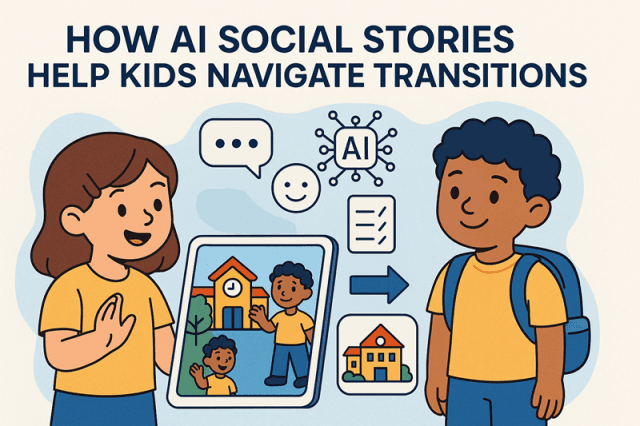
This is where AI Social Stories are making a real difference. With the help of artificial intelligence, parents and educators can now create personalized behavior and transition stories that gently guide children through new experiences. These stories combine empathy, technology, and child psychology in a way that's both simple and powerful.
What Are Social Stories and Why They Matter
The idea of Social Stories originated from Carol Gray, who developed them as a teaching tool to help children with autism understand everyday situations. A Social Story explains what is happening, why it's happening, and what the child can do in response.
For example, if a child struggles with visiting the dentist, a Social Story might walk them through the process: sitting in the chair, hearing the buzzing sound, and knowing it's safe. These small, detailed stories help children prepare mentally and emotionally for situations that might otherwise cause distress.
Studies have consistently shown that structured stories improve social understanding and reduce anxiety in children with autism. Resources like Autism Speaks and Child Mind Institute highlight how effective this approach can be in easing transitions.
The Challenge of Transitions for Kids with Autism
Change can trigger deep discomfort for kids with autism. Even small adjustments, such as a substitute teacher or a new bedtime routine, can feel unpredictable and stressful.
Parents often spend hours preparing their children for upcoming changes, but explaining complex emotions or social cues isn't always easy. Traditional Social Stories help, but creating them manually takes time, creativity, and sometimes professional input.
That's where AI comes in — it gives parents and educators the ability to make personalized stories instantly, tailored to each child's specific needs and experiences.
How AI Is Transforming Social Story Creation
Artificial intelligence is reshaping how we create and use Social Stories. Platforms like Kidscribe.ai allow users to enter a few details such as the child's name, the situation they're facing, and the tone they prefer, and instantly generate a meaningful, personalized story.
For example, a parent can type “starting preschool” into the Kidscribe tool. Within seconds, the AI creates a short, gentle story introducing the idea of meeting new friends, following classroom rules, and feeling proud of learning something new. The language is positive and simple, helping children connect emotionally with the story.
This kind of customization was once time-consuming. Now it's fast, consistent, and adaptable to each child's emotional level. Tools like AutiSpark are also exploring similar ways to support special education through personalized learning.
Why Personalized AI Social Stories Work So Well
AI Social Stories combine evidence-based psychology with personalization. They can adjust tone, length, and complexity, which makes them effective for children at different developmental stages.
When a story uses the child's own name and familiar details, it feels more engaging. Visuals created by AI can include calming colors and inclusive characters that represent the child's world. For parents and teachers, it means they can focus less on writing and more on connecting with the child during reading time.
Researchers have found that personalized approaches significantly improve learning outcomes for children with autism. Studies in journals like Frontiers in Psychology point to the benefits of tailoring content to individual learners, especially for emotional and behavioral development.
Everyday Uses for AI Social Stories
AI Social Stories can be used across many real-life situations. Parents create bedtime stories that encourage calm routines. Teachers use them to introduce classroom expectations. Therapists design them for specific challenges such as making eye contact or sharing toys.
Common Real-Life Social Story Examples
-
Visiting the dentist
-
Starting a new school year
-
Taking the bus for the first time
-
Moving to a new home
-
Learning to say goodbye at drop-off
Each of these examples helps children prepare emotionally and mentally before the actual event. The stories make unfamiliar experiences more predictable and reduce stress for both the child and the caregiver.
Keeping It Safe and Human-Centered
While AI offers incredible convenience, it should always complement human care, not replace it. Parents and educators remain central to how these stories are shared and discussed. The goal isn't to automate empathy but to make it easier to express.
Ethical AI tools, such as Kidscribe.ai, emphasize privacy and data protection. They do not store sensitive child information beyond what's needed for story generation. Organizations like UNICEF stress the importance of transparency and child safety in any technology used for education.
How to Get Started
Using an AI Social Story generator is simple. Visit Kidscribe.ai/social-stories, choose the story type such as behavior, transition, or social skill, and add a few personal details. Within moments, you'll receive a ready-to-read story that can be printed or shared digitally.
Other trusted resources, like Do2Learn or the Social Stories Creator & Library App, also offer tools and templates for parents who prefer manual customization.
The Future of AI and Autism Education
The use of AI in autism education is still growing. Experts believe the next step will involve integrating voice and visuals, so stories can be read aloud by friendly characters or displayed through interactive animation.
Researchers at NIH and EdTech Magazine are exploring how technology can bridge emotional gaps and improve inclusivity in classrooms. The combination of AI and emotional storytelling could make learning more personal, compassionate, and empowering for every child.
FAQ: AI Social Stories, Autism, and Transitions
Q1. What are AI Social Stories?
AI Social Stories are personalized digital narratives created with artificial intelligence to help children, especially those with autism, understand everyday situations and transitions. They combine visual and written elements to teach emotional and behavioral responses in a supportive way.
Q2. Are AI Social Stories only for children with autism?
Not at all. While they are highly effective for children on the autism spectrum, AI-generated social stories can also support children with ADHD, anxiety, or any child who needs help adjusting to new experiences or social situations.
Q3. How does Kidscribe.ai help parents and teachers?
Kidscribe.ai simplifies the process of creating personalized behavior and transition stories. Parents and educators can generate custom stories by entering a few details, allowing them to spend more time engaging with the child instead of writing or illustrating stories from scratch.
Q4. Are AI Social Stories safe to use?
Yes, as long as you use trusted tools that follow data privacy standards. Platforms like Kidscribe.ai do not store or share sensitive child data. Always review a platform's privacy policy before sharing any information.
Q5. Can AI-generated stories replace human interaction?
No. AI Social Stories are meant to support, not replace, human care. The best results come when parents, teachers, or therapists read and discuss the stories with children to help them apply lessons in real life.
Q6. What makes AI Social Stories different from traditional ones?
Traditional stories require manual writing and illustration. AI stories are faster, adaptive, and customizable. They can include the child's name, preferences, and emotional needs, making them feel more relatable and effective.
Conclusion
Transitions will always be part of a child's growth, but how they experience them can make a world of difference. AI Social Stories offer a way to turn fear into understanding, hesitation into confidence, and confusion into calm.
By combining proven educational methods with the power of AI personalization, tools like Kidscribe.ai are helping parents, teachers, and therapists guide children through life's many changes with patience and empathy.
Technology may be the engine, but human love and understanding remain the heart of every story.